Skip to content
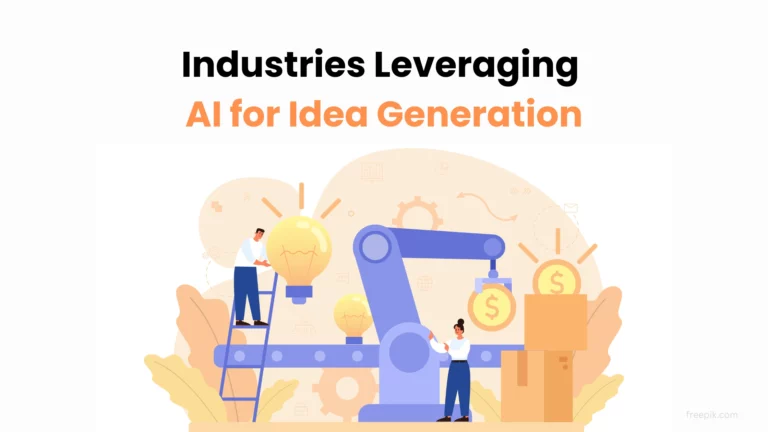
Today, it’s common knowledge that almost every industry today is leveraging AI in some form to augment how they work.
From operations and analytics to customer experience and R&D, AI has quietly become part of everyday decision-making.
It’s no surprise then that lists of the best AI tools for 2026 increasingly include platforms for idea generation, innovation management, and IP protection, and not just automation or content creation.
Who would’ve imagined AI-suggested wine blends aligning with market demand while still preserving artisanal quality?
Or farmers using AI to ideate crop strategies based on soil health and climate models?
From luxury goods and agriculture to deep-tech R&D, AI has firmly established itself as a catalyst for innovation.
Let’s look at where AI is making the biggest impact when it comes to idea generation, and how different industries are using it in practice.
#1 Product Innovation
Whether you are from the F&B industry, automotive market, or global consumer electronics, you have to understand the implications of not using AI. You will lack behind your competitors who are.
Say you are a sportswear company planning its next running shoe line.
Earlier you might have held conferences and team meetings for brainstorming with your designers, marketers, product developers, and more.
You might have been able to get them all in one room and fill up your whiteboard with ideas.
But were they free of past models recycling, personal biases, and extroverts championing the meeting?
With an AI-powered idea generation tool, you could have had access to:
- Global running trends: What materials are gaining traction? What complaints do runners have?
- Performance data: Which design tweaks have historically improved speed and comfort?
- Cross-industry insights: Could biodegradable sneaker tech from the fashion industry or shock-absorbing materials from aerospace be applied?
- Customer sentiment: What pain points do marathon runners discuss most in reviews and forums?
With a conversation, the AI generates hundreds of unique, data-backed concepts and helps you build on your idea while keeping you in check.
Maybe it suggests a self-healing sole inspired by medical bandages. Or a temperature-adjusting fabric based on climate-adaptive clothing.
The result? Instead of spending weeks narrowing down ideas, you already have high-potential, validated concepts. And teams working on it, collaboratively.
#2 Design & Creativity
The much talked AI generated Christmas commercial by Coca Cola. It just threw the internet into a frenzy. Debates and controversies.
But what’s real is that AI is transforming graphic design, fashion, architecture, marketing, and media production, helping creatives push boundaries.
Maybe the ad didn’t land well this Christmas, but AI surely will improve. The artists will leverage AI.
Think about owning a luxury furniture brand and looking to design its next statement piece—a chair.
But you don’t just need a functional chair but an aesthetic and ergonomic one.
If you access an AI-powered idea generation tool, such as Inventor Assistant by InspireIP, rather than relying solely on human intuition, you get:
- Centuries of furniture design history: Identifying timeless patterns and untapped design languages.
- Cross-industry inspirations: Could biomimicry from nature or lightweight aerospace materials redefine chair design?
- Consumer behavior trends: What styles and materials are gaining traction globally?
- Ergonomic data: What chair designs have led to the most comfort and health benefits?
All of it in seconds!
Then you get to engage in a meaningful and intellectual conversation to produce hundreds of unique, unconventional designs.
Perhaps a 3D-printed, self-adjusting seat inspired by the human spine or a modular, shape-shifting chair that adapts to different postures?
You unlock new possibilities, and bringing truly innovative designs to life.
#3 Business Strategy & Marketing
We, at InspireIP, have a dynamic marketing team. And speaking from experience, our marketing efforts and business strategy have improved so much by leveraging AI.
Our turning point? Realizing that our customers and users aren’t just looking for an innovation tool, they want to upgrade their entire innovation process.
But how did AI help us get there?
- AI-Powered Market Insights: AI analyzed thousands of innovation trends, patent filings, and industry shifts, helping us understand what truly matters to our audience.
- Product Optimization: We got to know that our audience wants us to optimize our product for AI idea generation, prior art searches, evaluation phases, implementation, and reporting. All while maintaining security, data privacy, and a Responsible AI approach.
- Personalized Content Generation: AI-assisted writing tools helped us craft blog posts, case studies, and landing pages tailored to the exact pain points of innovation managers, patent attorneys, and IP professionals.
- Competitive Scouting: AI scoured competitor strategies, tracking keyword trends and engagement metrics, helping us position InspireIP as the leading AI-powered innovation management solution.
The result? Our AI-backed strategies didn’t just increase engagement, they helped us align our product with real user needs.
And this is just us. From Fortune 500 brands to emerging startups, AI is reshaping how businesses craft strategies, optimize marketing, and stay ahead of the competition.
The Bigger Shift: How Ideas Are Born
Across industries, the biggest change isn’t that AI is “creating ideas.”
It’s that:
- Ideas are no longer limited to loud voices in a room
- Signals from data, customers, and operations are finally being heard
- Innovation is becoming continuous, not episodic
AI doesn’t replace human judgment. It removes blind spots, accelerates exploration, and helps teams focus on ideas that actually matter.
And that’s why industries leveraging AI for idea generation are innovating faster and they’re innovating smarter.