Skip to content

Over the past few years, we have worked with organizations trying to strengthen their invention and IP pipelines. As part of it, we speak with IP counsel and innovation leaders almost every day. One problem that keeps coming up in these conversations is that companies are not short of ideas. They are struggling to capture enough of them.
You might think that, with tools like ChatGPT, Claude, and others, the gap would be getting smaller. Yet giving employees access to AI tools does not automatically create a reliable way to identify, develop, document, and review potentially valuable inventions.
That is where dedicated AI invention capture systems come in. These platforms are designed to make it easier for inventors to share what they are working on, develop rough ideas into stronger disclosures, and give IP teams better information to evaluate.
In this guide, we look at six top AI invention capture systems organizations can consider in 2026, We break down how each approaches invention capture, its notable features, and where it may fit best.
Which AI Invention Capture Systems Are Right For You In 2026 And Beyond?
For this list, we focused on platforms where AI is involved early enough to influence how an invention is captured, developed, or evaluated.
That includes tools that guide inventors through disclosure with contextual questions, turn rough technical material into structured invention records, and surface missing information. Some of these tools even help IP teams assess a disclosure before it moves further into the patent process.
We consciously excluded platforms where AI sits elsewhere in the IP lifecycle but does not meaningfully participate in invention capture itself. On that note, these are the six tools worth exploring:
- InspireIP
- Tradespace
- CPI Idea Foundry
- Questel Equinox Invention
- IP Author
- Wellspring Evolve
Let’s look at them one by one, starting with InspireIP.
1. InspireIP
InspireIP is, in essence, an AI-powered invention management and disclosure platform that helps companies capture ideas earlier and move the strongest ones toward IP review. The platform covers capabilities such as idea collection, invention harvesting, disclosure development, prior art review, evaluation, and integration with existing IP systems.

Source – InspireIP
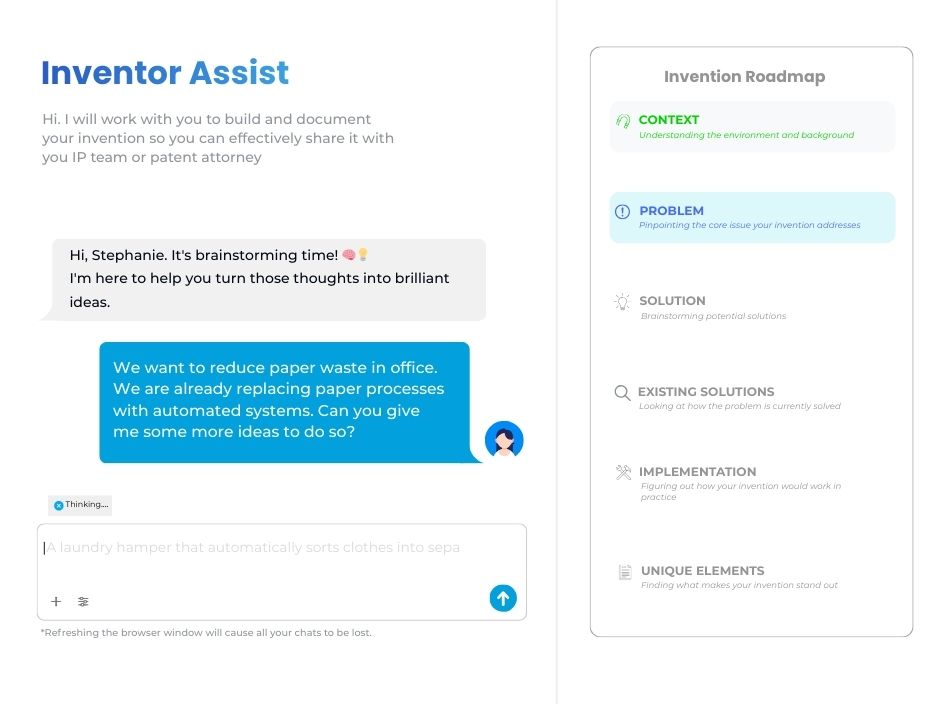
Its Inventor Assist product is built to support inventors who have an idea worth documenting, but may not yet have a polished invention disclosure.
With InspireIP, an inventor can start with a rough note, technical concept, experiment, sketch, document, or supporting material. Inventor Assist then asks contextual questions to understand the problem, how the idea works, what may be new, and where else the invention could be applied. The information is organized into a structured disclosure for IP review.
Fun fact: InspireIP also works before an invention reaches the disclosure stage. Our platform is equipped to collect ideas from platforms like Teams, Google Chat, Slack, Jira and more, so ideas created during everyday work have a path into the innovation process. Further, the platform also enables organizations to collect and develop ideas through innovation challenges.
That’s not where it ends. Once an idea starts taking shape, InspireIP can help evaluate it before it moves further. With AI-assisted prior art search capabilities powered by PQAI, inventors can check how novel an idea may be and refine it based on what they find. The generated disclosure can then be sent to the IP team for review and, if approved, passed into existing docketing or IP management systems for the next stage of the patent process.
Notable Features
Here are the notable features of InspireIP:
- PQAI-powered prior art search: InspireIP brings prior art into the invention review stage, so inventors and IP teams can see what already exists and get an early read on novelty before spending more time on an idea.
- AI Evaluation Assist: Reviewers can use AI alongside their own evaluation criteria when assessing disclosures, rather than relying only on manual review or scattered comments across documents.
- Innovation Challenges: Companies can run focused challenges around a technical problem, product gap, or strategic priority to actively surface ideas from employees instead of waiting for disclosures to arrive organically.
- Idea capture from everyday tools: InspireIP connects with platforms such as Microsoft Teams, Google Chat, Slack, and Jira, so ideas discussed during day-to-day work can be captured before they disappear into messages or project threads.
- Works with existing IP systems: InspireIP integrates with IP management and docketing platforms such as Anaqua, Symphony, IPfolio, Equinox, and more. Companies can use the platform for invention capture and development without having to replace the system they already use for downstream IP management.
Who is InspireIP Best Suited For?
InspireIP is best suited for:
- Companies where engineers and researchers have ideas but do not consistently complete invention disclosures.
- IP teams that spend too much time going back to inventors for missing technical details.
- Enterprises that already have an IP management system but need a stronger invention capture layer in front of it.
- Organizations that want idea capture, invention disclosure, prior-art review, and internal evaluation in one platform.
Pricing
Pricing is customized based on your organization’s needs. You can reach out to our team for more information.
Ratings
G2 – 4.8/5
2. Tradespace
Tradespace is an AI-native IP management platform that covers invention capture, patent filing, portfolio management, and commercialization in its platform. Its invention harvesting product is designed to make disclosure generation easier for inventors who may not have the time or context to complete a traditional invention disclosure form.

Source – Tradespace
Inventors can upload notes or files through the Tradespace Inventor Portal, and its AI turns that material into a detailed disclosure covering the background, novel features, advantages, and potential use cases.
Notable Features
- Works with existing workflows: Tradespace can integrate with tools such as Slack, Gmail, and Notion, helping inventors bring work they have already created into the disclosure process instead of starting again in a separate system.
- Patentability and IP assessment: Tradespace can evaluate a disclosure against prior art and generate an IP Assessment Report. The analysis can include novelty, market potential, inventor information, and other material relevant to the review process.
- Connects capture with the broader IP lifecycle: Invention harvesting sits inside a wider platform for patent filing, IP management, and commercialization. This allows inventions that move forward to remain within the same environment rather than being handed off to an entirely separate system.
Best for: High-growth companies and lean IP teams that want inventors to submit existing technical material instead of completing lengthy disclosure forms, while keeping invention capture, filing, and portfolio management connected.
3. Idea Foundry
Idea Foundry is an AI-powered invention capture tool built into CPI’s Disclosure Management System. It replaces static disclosure forms with guided AI conversations that help inventors explain an idea, clarify technical details, and turn early concepts into more structured invention disclosures.

Source – Idea Foundry
With the platform, inventors can review and edit AI-generated content, collaborate with co-inventors, and validate technical details before submitting the disclosure. The tool aims to give IP counsel a more complete, draft-ready invention package while reducing the back-and-forth typically required to fill gaps in an initial submission.
Notable Features
- AI-generated figures and drawings: Idea Foundry can create supporting figures and drawings from an inventor’s description. Inventors can review and refine these visuals before including them with the disclosure.
- Disclosure similarity analysis: The platform identifies potentially overlapping inventions and can recommend when related disclosures should be combined, helping IP teams spot duplication before moving toward filing.
- Patentability and prior-art insights: Idea Foundry also analyzes patent and portfolio data alongside submitted disclosures to provide additional context for patentability review and help IP teams prioritize which inventions warrant further attention.
Best for: Corporate IP teams that frequently receive incomplete disclosures and want guided AI intake, co-inventor collaboration, supporting figures, and early patentability context before attorney drafting begins
4. Questel Equinox Invention
Questel’s Equinox Invention is a collaborative invention management platform for collecting disclosures, assessing submissions, and moving inventions toward filing decisions. It gives inventors, co-inventors, reviewers, and other stakeholders a centralized workspace and can be configured around an organization’s existing invention review process.

Source – Questel
The AI component here comes through Qthena, Questel’s separate AI assistant that integrates with Equinox. Qthena includes an Invention Disclosure Generation workflow that uses an interview-style format to ask inventors structured questions about the problem, solution, and advantages of an invention. It then uses those responses to develop a more complete disclosure.
Notable Features
- Semantic prior-art search: Equinox Invention can automatically search for similar patents based on the concepts and keywords in a disclosure, giving reviewers early prior-art context during evaluation.
- Customizable invention workflows: Organizations can go as far as configuring roles, access rights, submission processes, reports, remuneration, digital signatures, and document generation around their existing process.
- Voice-assisted disclosure input: Qthena supports voice-to-text prompts, giving inventors another way to explain technical concepts during the disclosure process instead of relying entirely on written input.
Best for: Large enterprises with formal invention review processes that need highly configurable submission, approval, and decision workflows.
5. IP Author
IP Author is a generative AI platform designed for patent professionals with a dedicated Invention Management product for capturing and developing invention disclosures. The platform guides inventors through an attorney-aligned intake process using AI-assisted questions that help surface the technical details needed before an invention can move towards drafting.

Source – IP Author
The inventor responses are organized into a structured, draft-ready disclosure, giving in-house IP teams a more complete starting point for review. By collecting important information upfront, the platform is designed to reduce clarification cycles and help inventions move from initial submission toward patent preparation faster.
Notable Features
- Disclosure similarity checks: IP Author can compare invention disclosures and flag potentially overlapping submissions before filing, helping teams identify duplicate or closely related inventions.
- Connected prior-art analysis: Invention Disclosure Forms can be linked with IP Author’s Search module, allowing teams to review prior art alongside the invention during evaluation.
- Private AI environment: IP Author states that customer data is not used for model training and offers Zero Data Retention options. The platform is also SOC 2 Type II compliant.
Best for: In-house IP teams and patent professionals that want a focused generative AI workflow for turning inventor input into draft-ready disclosures, with prior-art analysis and duplicate detection built close to the intake process.
6. Wellspring Evolve
Wellspring Evolve is an IP management platform covering invention disclosures, patent management, commercialization, and related IP workflows. Its AI capabilities extend into invention capture by helping improve the information collected during disclosure intake.

Source – Wellspring Evolve
Rather than relying only on what an inventor manually enters into a disclosure form, Evolve can use AI to parse information from materials such as manuscripts, lab notes, and abstracts. This gives IP teams additional technical context earlier in the process and can help improve the quality of disclosures before they move into review.
Notable Features
- Early patentability and commercial signals: Wellspring can provide patentability and commercial-viability signals during triage, giving reviewers additional context when deciding which inventions deserve further attention.
- Research-based invention identification: Its AI can analyze grant abstracts to help surface potentially high-value inventions earlier and prompt outreach to researchers.
Best for: Universities, research institutions, and R&D-intensive companies where inventions often emerge from manuscripts, lab notes, abstracts, and funded research, and need to move into disclosure, evaluation, and commercialization workflows.
Now that we had a look at the tools, you might be wondering which is the right fit for you. The next section can make the decision easy.
How to Choose the Right AI Invention Capture System For Your Organization?
When it comes to choosing the right tool, features matter. But there are far bigger questions to answer.
Let’s look at those questions so you can decide which tool is the right fit for you.
1. How Easy Is It for Inventors to Share an Idea?
If the system still expects inventors to sit down and complete a lengthy form, adoption may remain a problem.
It is important to look for tools that let inventors start with what they already have, whether that is a rough note, sketch, technical document, experiment, conversation, or supporting file. Guided AI can also help by asking the right follow-up questions and turning that starting point into something the IP team can actually review
2. How Much Does the AI Help Develop the Disclosure?
While most tools boast AI, not every AI feature adds the same value. Some tools mainly organize or summarize information, while others actively help surface missing technical details, identify possible novelty, or structure the invention into a stronger disclosure.
If incomplete submissions are already creating back-and-forth between inventors and IP counsel, this is one of the most important differences to look at.
3. What Happens Before and After the Disclosure?
Invention capture does not begin and end with the disclosure form. A stronger system should help organizations surface ideas worth patenting, evaluate them through the right review channels, and move approved inventions into the next stage without creating another disconnected workflow.
4. How Much Control Do You Have Over AI and Your Data?
Invention data is sensitive, so AI governance cannot be an afterthought.
It is critical to check whether the platform uses your data for model training. You should also look at what security controls are available and whether your organization can decide where AI is used. The system should support your IP process without taking control away from inventors, reviewers, or counsel.
Now that you have a clearer idea of what to look for, there is one platform on this list that brings all four areas together particularly well.
Why InspireIP Is the Best AI Invention Capture System You Ought to Have
Whether you are building your invention capture process from scratch or already have an IP management system in place, InspireIP can fit into the way your organization works.
If you are starting fresh, the platform gives you one place to capture ideas, develop disclosures, evaluate inventions, and build a more structured IP pipeline. If you already use tools such as Anaqua, Equinox, Symphony, or IPfolio, InspireIP can integrate with them rather than forcing you to replace systems that are already working well.
Moreover, the platform can also be customized around your existing review and approval workflows, and implementation does not have to turn into a long, disruptive project.
If AI-powered invention capture has been on your roadmap, book a demo with us today. Our team can show you how InspireIP would fit into your current setup and what implementation could look like for your organization.
Frequently Asked Questions
1. Do AI invention capture systems replace invention disclosure forms entirely?
Not always. Some platforms replace static disclosure forms with guided AI conversations, while others use AI to improve the information collected through existing forms. The goal is usually to reduce the burden on inventors and help IP teams receive more complete disclosures, rather than force every organization into the same process.
2. How secure are AI invention capture systems for confidential or pre-patent ideas?
Security varies by platform, so organizations should review how invention data is stored, processed, and retained by the platform. It is also important to check whether customer data is used for model training, what access controls are available, and whether the provider supports relevant security certifications. For sensitive inventions, AI governance and data handling should be part of the buying decision.
3. Can AI invention capture software work with an existing IP management system?
Yes. Several invention capture platforms are designed to integrate with existing IP management and docketing systems. This allows organizations to improve idea capture, disclosure development, and early evaluation without replacing the systems already used for prosecution, docketing, portfolio management, or renewals.