Skip to content

Hackathons were once seen as weekend coding sprints for students or open-source enthusiasts. But now they have evolved into powerful engines for innovation, ideation, and talent discovery.
In 2025, they were increasingly used by corporations, academic institutions, non-profits, and even marketing teams to crowdsource ideas, test prototypes, and jump-start new initiatives.
2026 is only going to see an uptrend and hackathons will be critical for:
- Accelerating internal innovation
- Solving organizational challenges
- Discovering talent
- Testing prototypes faster
- Engaging employees in problem-solving
- Feeding the innovation pipeline with high-value idea
But running a hackathon, especially a virtual or hybrid one, can be logistically overwhelming. That’s where hackathon software comes in: it automates registration, team formation, idea submission, judging, collaboration, and even post-hackathon innovation tracking.
In this post, we’ll walk you through the top hackathon software platforms in 2026, show who they work best for, and help you choose the right one for your needs.
Pro tip: bookmark this, because every year new tools emerge and we’ll try to update this list for 2027 too.
Why Use Hackathon Software?
Before we see the platforms, here’s why hackathon software is no longer a “nice-to-have,” but often a necessity:
- Streamlined Management: From registration to final submissions, hackathon software automates many of the logistical aspects of running a hackathon.
- Enhanced Collaboration: Participants can easily collaborate, share ideas, and work on projects in real-time, regardless of their physical location.
- Idea Generation: Specialized features like brainstorming sessions, voting mechanisms, and idea repositories help in capturing and refining innovative ideas.
- Project Tracking: Track the progress of each project, assign tasks, and ensure deadlines are met.
- Feedback and Judging: Simplify the process of gathering feedback from mentors and judges, making it easier to evaluate and select the best projects.
- Scale & scope: As hackathons grow larger, globally distributed, with hundreds or thousands of participants, manual tracking becomes impossible. Software helps manage registration, submissions, teams, judging, and communications in a structured way.
- Diverse formats: Today’s hackathons aren’t just coding, many are about product design, AI/ML prototypes, marketing ideas, business models, UX, and more. A good platform supports multiple formats (code, design, idea-submission, voting, etc.).
- Global reach + remote collaboration: With participants from different geographies, time zones, and backgrounds, platforms help schedule, manage collaboration, and provide centralized submission/judging processes.
- Post-event value: Some platforms go beyond one-off events and help organizations track and nurture promising ideas, bridging hackathons with longer-term innovation pipelines.
- Data & analytics: For companies that treat hackathons as strategic tools, analytics, on participation, engagement, idea quality, follow-up outcomes, help assess ROI, understand trends, and shape future events.
Which Hackathon Software Should You Choose? (2026 Decision Matrix)
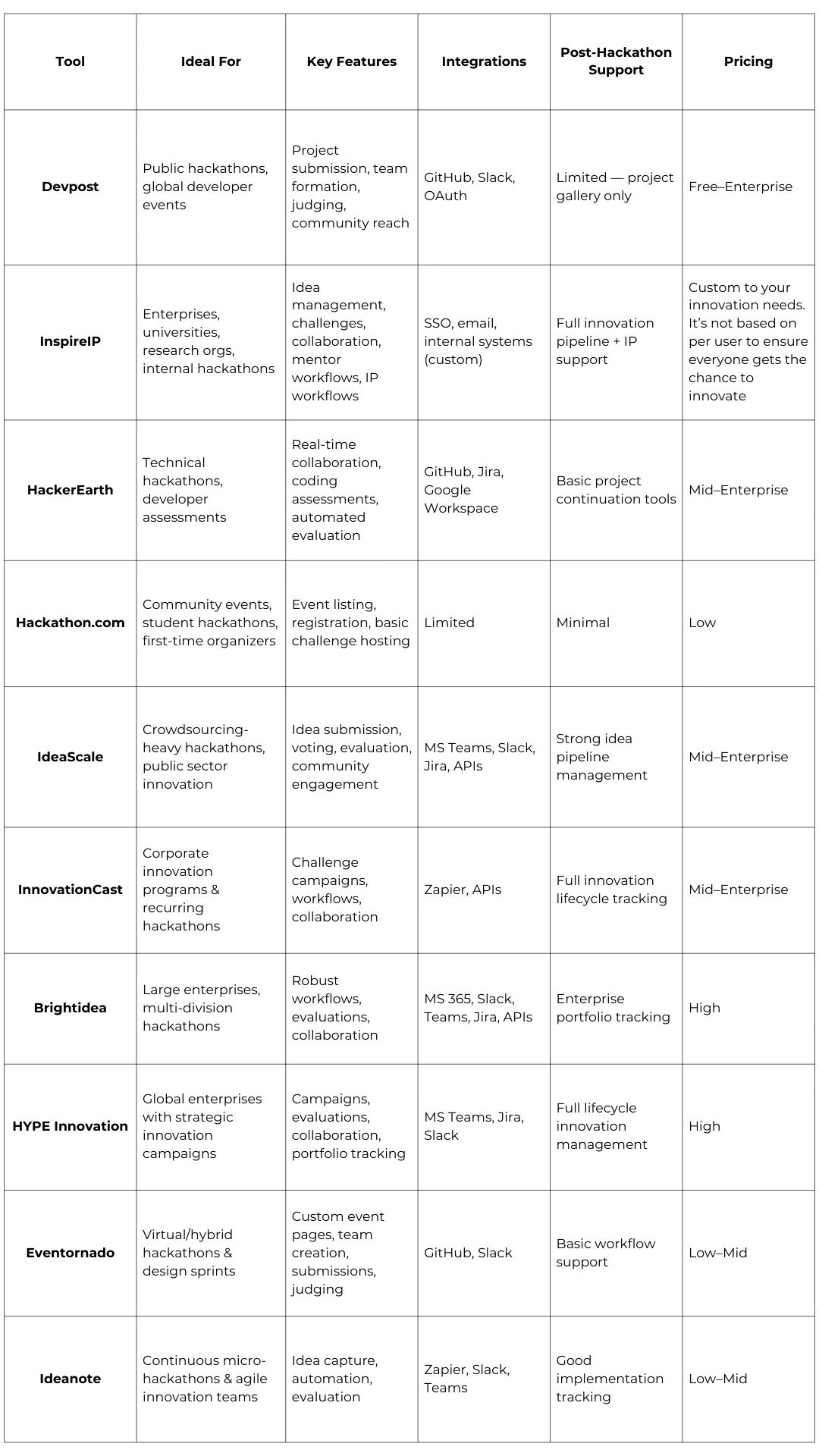
Top Hackathon Software Solutions
1. Devpost
Best For: Large-scale online hackathons, global developer challenges, and organizations looking to attract thousands of participants from around the world.
Features
- Comprehensive Project Showcase & Submission Management
Devpost makes it incredibly easy to collect, display, and review thousands of project submissions in a clean, standardized format. Each project gets its own public page with demos, write-ups, and GitHub links, perfect for judges and community voting. - Built-In Team Formation & Discovery
Participants can browse skills, interests, and open team spots, helping strangers form teams quickly, ideal for global hackathons where people join virtually. - Community Voting & Public Engagement
Devpost’s upvoting, likes, and commenting features help highlight crowd favorites. This is especially useful for hackathons that want a “people’s choice” element or want to increase event visibility. - Deep Integrations for Developers
Seamless GitHub integration (and other dev tools) makes it easy to link code repositories, track updates, and manage builds—all inside the platform.
Why It Stands Out
Devpost’s biggest strength is reach and reputation.
It already has a massive global community of developers, students, and makers who actively browse for new challenges. This makes it the platform of choice when you want:
- huge participant turnout
- wide visibility
- public project galleries
- community voting
- a “hackathon as a public event” experience
If your goal is brand visibility and large-scale online participation, Devpost is the default go-to.
2. InspireIP
Best For: Growing companies, large enterprises, nonprofits, and universities that want end-to-end hackathon workflow to solve innovation challenges. And, innovation management, not just idea capture. Essentially, companies that want to run both internal innovation challenges and external public hackathons.
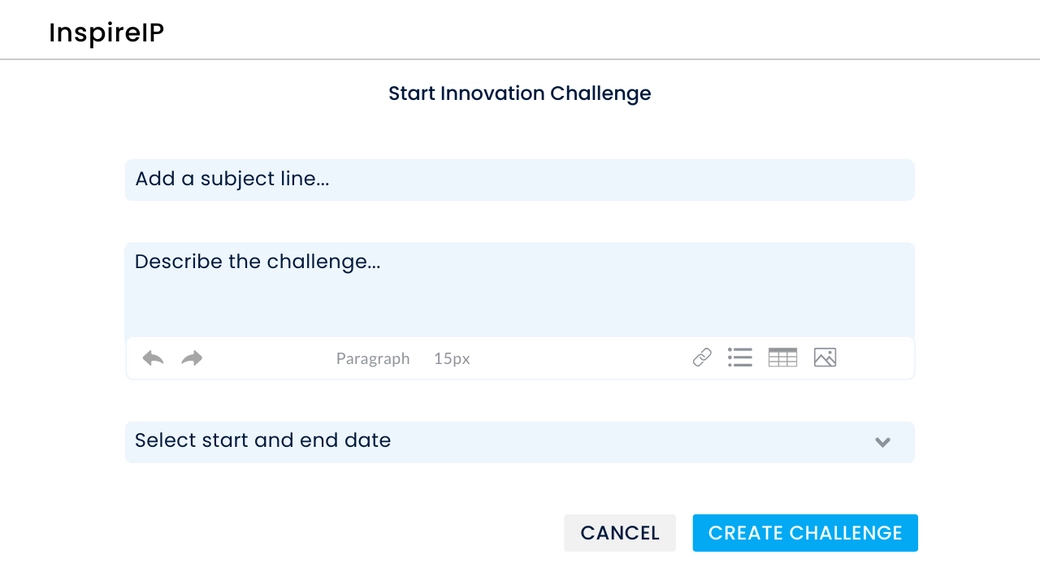
Features
- Idea Lifecycle Management
This is InspireIP’s superpower: You don’t lose the ideas once the hype dies. Every idea moves through a customizable workflow, from submission, problem validation, and prototype to evaluation and post-hackathon development.- Idea intake
- Evaluation
- Voting
- Prioritization
- Implementation tracking
This bridges the gap between hackathon energy and real organizational innovation.
- Security & Compliance for Regulated Industries
SOC 2 Type II, SSO/SAML, user provisioning, and enterprise compliance support make Brightidea a safe choice for finance, telecom, pharma, and government. - Flexible Workflow Engine
One of InspireIP’s biggest selling points is its ability to adapt to your innovation process. You can customize review stages, approval flows, evaluation criteria, hackathon & innovation challenge templates, and stakeholder involvement, making it suitable for both simple hackathons and year-round innovation programs. - Easy for Participants AND Organizers
Clean UX, no learning curve, and zero friction even for first-time hackathon software participants. Built-in commenting, updates, attachments, and team workspaces keep everyone aligned without needing Slack threads, emails, and Google Docs everywhere. - Analytics That Show What’s Worth Building
Track participation, engagement, idea quality, team progress, and post-hackathon traction, giving leaders a clear sense of what deserves investment. - Integrations for Enterprise Use
Connect with Slack, Microsoft Teams, Jira, and project management systems to maintain continuity after the event.
Why InspireIP Stands Out
Most hackathon platforms stop the moment the event ends. InspireIP was built specifically to bridge the gap between hackathons and real innovation.
It ensures:
- Ideas don’t get abandoned
- Teams stay accountable
- Leaders know which concepts have long-term potential
- Post-event tracking is structured, not ad-hoc
This continuity helps organizations turn hackathon outcomes into a measurable innovation pipeline.
3. HackerEarth
Best For: Companies that want to run both internal innovation challenges and external public hackathons, especially when technical assessment, collaboration, and structured execution matter.
Features
- Real-Time Collaboration Environment
HackerEarth provides a built-in, real-time collaboration space where participants can code, brainstorm, and iterate together, no matter where they’re located. This is especially helpful for hybrid or fully remote hackathons. - Mentorship & Expert Guidance Tools
You can assign mentors to teams, enable Q&A rooms, and offer live feedback. This dramatically improves the depth and polish of submissions because teams don’t get stuck mid-way. - Developer Assessment Tools (Unique to HackerEarth)
Because HackerEarth started as a developer hiring and coding assessment platform, hackathons also benefit from:- built-in coding tests
- automated scoring
- skill-based leaderboards
This makes it particularly strong for organizations that want to combine innovation events with talent identification.
- Themed Challenge Templates
Cybersecurity, AI/ML, fintech, sustainability, you’ll find ready-to-launch challenge formats that reduce organizer setup time. - Scalability for Both Internal & External Events
HackerEarth can handle small internal departmental hackathons as well as massive open innovation challenges with thousands of registrants.
Why It Stands Out
HackerEarth stands out because it’s designed for serious, high-quality innovation output.
While platforms like Devpost focus more on visibility and global participation, HackerEarth brings:
- structure
- coding depth
- mentor-driven support
- assessment capabilities
- controlled environments for internal teams
This makes it an excellent choice for companies that want hackathons to not just create ideas, but to produce workable prototypes and identify top talent simultaneously.
4. Hackathon.com
Best For: Organizers who want a simple, straightforward platform to list, promote, and host hackathons, especially smaller events, beginner-friendly hackathons, and community-driven initiatives.
Features
- Community Engagement Through a Global Directory
Hackathon.com is best known for its massive public directory of hackathons. Listing your event gives you instant visibility among developers, students, and hobbyists who actively browse the platform for upcoming challenges. - Built-In Event Promotion Tools
You can publish event pages, highlight themes, share updates, and attract organic participants without needing heavy setup or technical configuration. - Simple Registration & Participant Onboarding
Hackathon.com keeps the registration flow clean and familiar, making it easy for first-time organizers and participants to get started. - Lightweight Hosting Capabilities
While not as feature-rich as platforms like Devpost or HackerEarth, it supports the essentials you need to run a basic hackathon.
Why It Stands Out
Hackathon.com shines because of its simplicity and discoverability.
If your goal is to run a fun, engaging hackathon without navigating complex workflows, this platform is perfect. It’s also ideal for organizers who want to tap into an existing global audience but don’t need advanced features like real-time collaboration, mentor routing, or post-hackathon innovation tracking.
Think of it as the “just plug in and go” option which is perfect for smaller organizations, nonprofits, universities, and first-time event hosts dipping their feet into hackathons.
5. IdeaScale
Best For: Organizations that see hackathons not as one-off events but as part of a broader, continuous innovation program. Ideal for enterprises, governments, universities, and global communities running long-term idea challenges.
Key Features
- Deep Crowdsourcing Engine
IdeaScale’s biggest strength is its ability to activate large communities to submit, vote, refine, and collaborate on ideas before, during, and after a hackathon.
This makes it a powerful tool when your hackathon is designed to gather broad input rather than just build prototypes. - Idea Management That Starts Before the Hackathon
Participants can submit, refine, and collaborate on ideas even before Day 1. This helps you kick off with sharper concepts instead of blank-page panic. Instead of stopping at project submissions, IdeaScale supports the full journey:- idea intake
- evaluation
- voting
- prioritization
- implementation tracking
- Advanced Workflow Automation
Automated routing, scoring, and evaluation workflows help teams manage high volumes of ideas without drowning in manual work. - Community Engagement Tools
Discussion threads, voting, sentiment analysis, and custom challenges help keep participants engaged beyond the hackathon. - Integrations for Enterprise Use
Connect with Slack, Microsoft Teams, Jira, and project management systems to maintain continuity after the event.
Why It Stands Out
If your hackathon goal is purely project demos, IdeaScale might feel heavyweight.
But if you want to embed hackathons into an ongoing innovation engine, IdeaScale is one of the strongest platforms on the market.
It excels at:
- large-scale idea crowdsourcing
- structured community engagement
- multi-stage evaluation workflows
- long-term tracking of ideas post-hackathon
Organizations that treat hackathons as a strategic innovation funnel (rather than isolated events) consistently choose IdeaScale for its depth and enterprise-level scalability.
6. InnovationCast
Best For: Organizations that want a collaborative, end-to-end innovation management platform to support hackathons and everything that happens before and after them. Ideal for enterprises, universities, accelerators, and digital transformation teams.
Key Features
- Strong Idea Crowdsourcing and Challenge Campaigns
InnovationCast lets you launch structured innovation challenges, perfect for pre-hackathon warmups or thematic sprints. Participants can submit ideas, vote, comment, and build momentum before the event even begins. - Customizable Innovation Challenges
Design challenges that fit your strategic themes like AI, sustainability, operational efficiency, customer experience, etc. - Collaboration Spaces for Hackathon Teams
Teams get shared workspaces where they can refine ideas, upload documents, receive feedback, and co-create prototypes that areideal for hybrid or fully virtual hackathons. - Post-Hackathon Implementation Tracking
InnovationCast doesn’t stop when the event ends. It continues supporting:- development plans
- progress tracking
- business case evaluations
- stakeholder reviews
- project handoffs
This makes it extremely valuable for teams that want continuity between hackathon excitement and real-world execution.
- Integrations
InnovationCast integrates with collaboration and productivity platforms like Microsoft Teams, Jira, and Google Workspace, helping teams stay aligned post-event.
Why It Stands Out
InnovationCast shines when your organization needs a scalable, structured, and highly collaborative innovation system and not just a hackathon hosting tool.
Here’s what sets it apart:
- robust support for multi-stage innovation pipelines
- flexible workflows adaptable to different innovation methodologies
- strong engagement features before, during & after the hackathon
- excellent for medium to large organizations that prioritize innovation continuity
If your hackathon strategy includes nurturing ideas into pilot-ready solutions, InnovationCast is a well-rounded and dependable platform.
7. Brightidea
Best For: Large enterprises that run complex, multi-department innovation programs and need a highly configurable platform to manage hackathons, idea pipelines, governance, and enterprise-wide innovation operations.
Key Features
- Enterprise-Grade Hackathon Workflows
Brightidea offers dedicated apps for innovation events, including hackathons. What makes it stand out is the administrative depth with structured submission flows, scoring dashboards, stakeholder routing, and detailed operational reporting. - Modular Innovation Apps
Unlike many platforms where hackathons are a general feature, Brightidea breaks its innovation tools into modular apps such as:- Hackathon
- Incubate
- Evaluate
- Explore
- Scout
This gives enterprises the ability to scale their hackathons into long-term programs without switching platforms.
- Integrations for Innovation Ops
Brightidea integrates with Jira, Confluence, Salesforce, Microsoft Teams, SharePoint, and ServiceNow. These integrations make it ideal for companies with heavy internal processes and cross-functional handoffs. - Executive Dashboards & ROI Tracking
Brightidea excels at measuring innovation outcomes, something many hackathon tools don’t do well. You get:- financial impact tracking
- pipeline metrics
- adoption & engagement analytics
- executive-level reporting
This focus on business value makes Brightidea especially attractive for enterprise innovation leaders who must justify budgets and outcomes.
Why It Stands Out
Brightidea is not just a hackathon tool, it’s a full innovation operations platform. Companies choose Brightidea when they:
- run hackathons across multiple business units
- need structured governance, approvals, and compliance
- require tight integrations with enterprise systems
- want detailed ROI visibility
- operate complex innovation pipelines with strict oversight
Its strength lies in program scale, workflow depth, and enterprise rigor, making it ideal for sophisticated innovation ecosystems, not lightweight hackathons.
8. HYPE Innovation
Best For: Large organizations that want strategic, consultant-backed innovation programs, including hackathons, crowdsourcing campaigns, and long-term innovation governance. Particularly strong for global enterprises, R&D-heavy companies, and industries where innovation must be structured and disciplined.
Key Features
- Strategy-Driven Innovation Campaigns
HYPE doesn’t treat hackathons as isolated events. The platform is built to support strategic innovation campaigns aligned with long-term goals of sustainability, digital transformation, product innovation, cost reduction, etc.
Its strength lies in connecting hackathon challenges directly with strategic objectives, ensuring every idea has relevance and executive sponsorship. - Strong Employee Engagement Mechanics
HYPE is known for its deep “innovation culture” features:- participation nudges
- gamification
- expert panel discussions
- campaign storytelling tools
- recognition systems
This makes it valuable for enterprises aiming to build ongoing engagement, not just event participation.
- Advanced Evaluation & Decision-Making Frameworks
Rather than basic voting or scoring, HYPE supports:- expert review committees
- multi-criteria evaluations
- feasibility scoring
- portfolio mapping
These are ideal for large companies where ideas move through formal gates and require cross-functional approval.
- Professional Services & Expert Guidance
A major differentiator: HYPE offers hands-on consulting support, helping organizations design hackathons, innovation campaigns, governance models, and change management programs.
For enterprises that need guidance on how to run innovation (not just software), this is a big advantage. - Post-Hackathon Pipeline Development
HYPE supports:- idea maturation
- pilot planning
- resource allocation
- business case evaluations
- portfolio analysis
Perfect for organizations that treat innovation as a continuous portfolio.
Why It Stands Out
HYPE Innovation excels because it blends software and strategic consulting. A combination rarely found in other hackathon platforms. Organizations choose HYPE when they want:
- innovation tied to enterprise strategy
- structured governance and review models
- cross-department hackathons that feed into a broader innovation portfolio
- long-term culture building, not just event management
- support from innovation experts who guide the entire process
It’s built for enterprises where innovation isn’t a one-off activity, it’s a governed, measurable, strategic system.
9. Eventornado
Best For: Organizers who want a fast, flexible, and modern platform tailor-made for virtual and hybrid hackathons.
Perfect for startups, universities, innovation labs, accelerators, and community-driven hackathons that need quick setup and a smooth participant experience.
Key Features
- Ultra-Fast Event Setup
Eventornado is designed for simplicity. You can launch a fully functional hackathon page—registration, team formation, idea submission, judging—in under an hour.
This makes it attractive for teams that don’t want complex configurations.
- Intuitive Submission & Teaming Experience
Participants can:- submit ideas
- browse other submissions
- form/join teams easily
- collaborate in a clean, minimal interface
The UX is modern and frictionless, especially compared to heavier enterprise platforms.
- Real-Time Judging & Scoring Tools
Judges get simple scoring dashboards, eliminating the usual chaos of spreadsheets. Eventornado supports custom evaluation criteria, weighted scoring, and automatic ranking. It is great for hackathons that need quick result turnaround. - Built for Virtual & Hybrid Events
Features like embedded livestreams, announcements, and a centralized communication feed make it ideal for remote-first hackathons. - API & Light Integrations
Eventornado integrates with essential tools (Slack, GitHub, Google Sign-In) and offers an API for more custom workflows without overcomplication.
Why It Stands Out
Eventornado shines because it focuses on speed, usability, and modern hackathon needs without the enterprise complexity of platforms like Brightidea, HYPE Innovation, or InnovationCast. Organizers prefer Eventornado when they want:
- a lightweight platform that “just works”
- fast onboarding for participants and judges
- a beautifully clean interface
- low overhead for setup and management
- an ideal tool for hackathons that don’t require full innovation pipelines
In short, Eventornado is the best blend of simplicity and modern UX among hackathon platforms which is a strong choice for lean teams and community hackathons.
10. Ideanote
Best For: Teams that want an easy, automation-friendly platform to run lightweight hackathons and ongoing idea programs.
Ideal for SMBs, innovation teams, universities, and digital-first organizations that prioritize continuous ideation and effortless user experience.
Key Features
- Always-On Idea Capture (Not Just Event-Based)
Ideanote is built for continuous innovation. Its “micro-innovation” approach lets teams capture ideas anytime—not just during hackathons—making it perfect for organizations that want ongoing engagement with employees or students. - Automated Workflows for Evaluation & Follow-Up
One of Ideanote’s biggest strengths is automation. You can set triggers like:- auto-routing ideas to reviewers
- automated approval workflows
- tagging and categorization
- nudges and reminders
- status updates sent automatically
This is especially useful for small teams who don’t have the bandwidth to manually manage hackathon submissions.
- Lightweight Challenge Campaigns
While not as heavy-duty as Brightidea or HYPE, Ideanote provides clean, simple challenge structures where participants can:- submit ideas
- collaborate
- like/comment
- track progress
This works well for smaller hackathons or internal “innovation sprints.”
- Extremely Modern, User-Centric Interface
Users love Ideanote for its fast onboarding, mobile-friendliness, minimal & clean UI, and intuitive flow for submissions and reviews. If you want high engagement without training teams, Ideanote delivers. - Easy Integrations for Automation Lovers
Ideanote integrates well with Slack, Microsoft Teams, Zapier, Google Workspace, Trello, and Notion. This makes it flexible for hackathons and ongoing innovation.
Why It Stands Out
Ideanote differentiates itself by being simple, modern, and highly automation-driven. Organizations choose Ideanote when they want:
- a “set it and forget it” innovation workflow
- lightweight hackathon hosting without enterprise overhead
- continuous innovation culture across teams
- automation to replace manual admin work
- frictionless user experience for participants
It’s especially strong for smaller teams or mid-sized organizations that want to run hackathons and maintain momentum afterwards without adopting a huge enterprise system.
Choosing the Right Hackathon Software
Selecting the right hackathon software depends on your specific needs and objectives.
For large-scale events with global participation, Devpost and HackerEarth offer robust solutions.
If you’re focused on long-term innovation management, InspireIP provides tools to track and develop ideas beyond the hackathon.
For smaller, community-driven events, Hackathon.com offers a user-friendly platform that’s easy to set up and manage.
- Clarify your goal first: Are you running a public hackathon? Or an internal ideation drive? This will determine which platform fits best.
- Sketch your event flow: registration → team formation → idea submission → judging → post-hackathon follow-up. Then match your flow against platform capabilities.
- Request demos / trial runs: Many platforms (especially enterprise-oriented) offer demos. Run a small pilot hackathon to test UX, workflows, and usability.
- Plan for post-hackathon: If you want to convert ideas into real projects — integrate idea tracking & follow-up processes from the start.
- Monitor metrics & feedback: Use analytics to track participation, idea quality, engagement, and conversion (from idea → prototype → project).
Conclusion
Hackathon software is no longer a luxury, it’s a necessity for running successful events that generate valuable ideas and manage projects efficiently.
Whether you’re a seasoned hackathon organizer or planning your first event, the right software can make all the difference. Evaluate your needs, explore the options mentioned above, and choose the tool that best aligns with your goals.
With the right hackathon management software in place, you’ll be well on your way to fostering innovation, driving collaboration, and turning ideas into reality.
FAQs: Hackathon Software & Platforms
1. What is the difference between hackathon software and hackathon platforms?
“Hackathon software” usually refers to tools focused on running the event itself, right from registration, submissions, judging to team formation and communication. “Hackathon platforms” are broader. They often include idea management, innovation tracking, collaboration tools, and post-event workflows. Platforms like InspireIP, Brightidea, or IdeaScale fall into this category because they support the full innovation lifecycle, not just the event.
2. What features should teams prioritize when selecting hackathon tools?
It depends on your goals, but the features most organizations look for include:
- Easy idea submission
- Team formation
- Real-time collaboration
- Judging and scoring workflows
- Integration with tools like GitHub, Slack, or Jira
- Post-hackathon tracking (for organizations that want continuity)
For enterprises, governance and analytics matter more. For universities, simplicity and cost are bigger factors.
3. Can hackathon platforms support post-hackathon innovation tracking?
Yes, but not all do. Platforms like InspireIP, Brightidea, HYPE Innovation, IdeaScale, and InnovationCast offer full post-hackathon pipelines, helping organizations track ideas, incubate them, and push them toward implementation. Lightweight tools like Devpost or Eventornado focus more on the event rather than long-term innovation.
4. How do I choose the right hackathon tool for my organization’s size and goals?
Here’s a simple rule of thumb:
- Universities & community events: Eventornado, Hackathon.com
- Growing companies & cross-functional teams: InspireIP, Ideanote
- Large enterprises with structured innovation: Brightidea, HYPE Innovation, InnovationCast
- Developer-focused global events: Devpost, HackerEarth
Match the tool to your event size, complexity, innovation maturity, and post-event goals.
5. Can hackathon platforms support hybrid or fully virtual events?
Most modern tools do. Platforms like HackerEarth, Devpost, Eventornado, and InspireIP excel at virtual and hybrid events with features like real-time communication, virtual team rooms, judging dashboards, livestream embedding, and cloud-based collaboration.
6. Are there free or low-cost hackathon tools for universities and non-profits?
Yes. Options like Eventornado, Hackathon.com, Ideanote (starter tiers), and InspireIP’s educational or nonprofit plans are commonly used by universities and non-profits that need budget-friendly solutions.
Some platforms also offer community licenses or one-time event pricing.
7. How secure is hackathon software for corporate innovation challenges?
Enterprise-level platforms typically offer:
- SSO / SAML
- Role-based access
- Data encryption
- Activity logs
- Regional data hosting
- SOC 2 or ISO certifications
Tools like Brightidea, HYPE, InspireIP, and InnovationCast are better suited for corporations with strict compliance needs.
8. Can hackathon platforms help prevent duplicate ideas and improve idea quality?
Yes, advanced platforms can. Tools like InspireIP (AI-powered PQAI), Ideanote, and IdeaScale can identify duplicate submissions, detect similar ideas, and surface the most promising ones using AI, clustering, and smart categorization. This leads to higher-quality ideas and less noise for reviewers.