Skip to content
We talk to IP managers, patent counsel, and in-house innovation leads every week. When the topic of disclosure tracking comes up, we often hear the same things.
- “We’re too small for something like that.”
- “Our docketing system already handles it.”
- “We manage with spreadsheets and it works for now.”
- “We’re using Perplexity and Copilot. We think that’s enough.”
Sometimes, those answers are completely reasonable. A small team handling ten or fewer disclosures a year may not need a separate system. A tight team with one person who has full visibility can manage without dedicated software. There are no two ways about it.
But there’s a point where informal systems stop working, and it usually happens quietly. This problem begins when the process grows beyond what one person or a spreadsheet can reliably manage. Say an inventor submits something that never gets reviewed. Or a disclosure sits in someone’s inbox during a crunch week. In the worst case, a public presentation goes out before a patent application is filed. By the time anyone notices, it may be too late to fix.
This article is about that threshold. That is, what changes when disclosure management becomes a real problem, and what a purpose-built system actually does about it. We will also walk you through where InspireIP’s IP Assist fits for organizations that have outgrown informal tracking without realizing how much risk has accumulated.
Why Informal Disclosure Processes Break Down?
Most organizations start managing invention disclosures the way they manage everything else in the early days: email threads, shared drives, and a spreadsheet someone built that the entire team learned to work around. The process usually begins to break in three ways:

Volume outpaces the process: One IP manager may be able to track fifteen disclosures a year from memory. Now add another thirty from two new R&D teams, and details begin to slip. Not because anyone is careless, but because the system was never built to handle that load.
People are out of the loop: A disclosure gets submitted to one person, who is traveling. Or it reaches the patent committee, but half the members haven’t seen the technical background. Outside counsel may even begin drafting claims with incomplete information because relevant prior art was not identified during intake. Each of those gaps costs time, money, or patent quality.
The record is incomplete: A reliable disclosure process should show which version was submitted, when it was submitted, who reviewed it, what comments were made, and what was approved. When that information exists only in someone’s inbox, a personnel change can make the complete history difficult, or sometimes impossible, to recover.
These aren’t edge cases. They are recurring patterns in organizations where invention activity has grown faster than the process used to manage it. That’s where an invention management system can help.
What’s that, you ask?
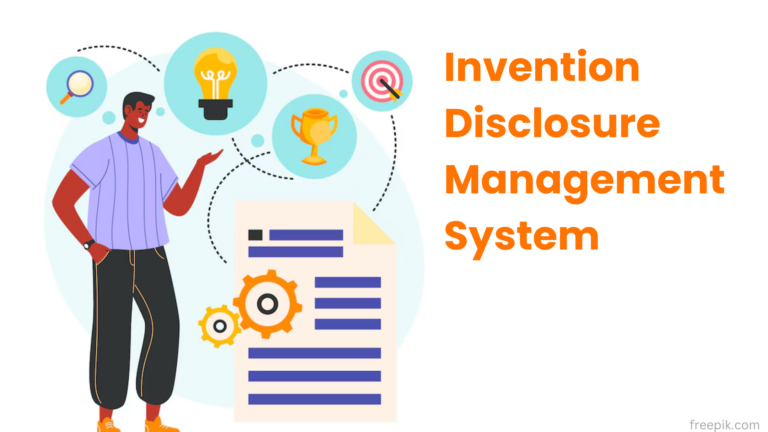
What a Disclosure Management System Actually Does?
The core job of a disclosure management system is straightforward. It ensures every submitted invention is captured completely, reaches the right reviewers, gets a real decision, and creates a record that holds up.
In practice, that means inventors submit through a guided intake process that prompts them for the right information upfront, so the disclosure arriving at legal is complete rather than requiring multiple rounds of follow-up.
Additionally, the review process is automated, so disclosures move through approval stages without anyone manually tracking who needs to do what next. It means the patent committee has everything in one place: the technical description, prior art references, comments from earlier reviewers, and a clear record of who has seen it.
It also means leadership can actually see what’s happening across the innovation program.They can see:
- How many disclosures are currently under review
- Which departments are contributing ideas
- Where reviews are slowing down
- How many disclosures progress to patent filings
- Which ideas are rejected, retained, or reconsidered later
That visibility is what turns an IP program from a cost center into something that can demonstrate strategic value.
Four Ways An Invention Disclosure Management System Improves the Workflow
Now that we have covered what a disclosure management system does, let’s look at what changes when an organization starts using one.
Inventors receive better guidance: Instead of working through a blank form, inventors are prompted to explain the problem, how the invention works, what makes it different, and who contributed to it. This helps legal teams receive more complete disclosures from the beginning.
Reviews move forward without constant follow-ups: The system routes each disclosure to the right reviewers, tracks pending actions, and sends reminders when required. This reduces the chances of an idea sitting unnoticed in someone’s inbox.

Patent committees receive complete context: Committee members can access the disclosure, supporting documents, prior art references, comments, and inventor responses in one place. This gives them the information they need to make and document a decision.
Every outcome remains recorded: Whether the organization files a patent, requests further development, retains the invention as a trade secret, or closes it after evaluation, the outcome and the reasoning behind it remain connected to the disclosure.
In short, the system gives inventors more guidance, helps reviews move forward, provides decision-makers with better context, and creates a reliable record of every outcome.
Now that you know how an invention disclosure management system can help, let’s look at how InspireIP support your growing disclosure program.
How IP Assist Supports Growing Disclosure Programs?
IP Assist is designed for organizations whose disclosure activity has become too complex for informal tracking. It connects inventors, IP teams, patent committees, and existing IP infrastructure through one structured process. Here’s how it stands out:
Guided Invention Capture
The process begins with Inventor Assist, which guides inventors through the disclosure form. It prompts them for technical details, potential applications, co-inventor contributions, and any prior art they already know about.
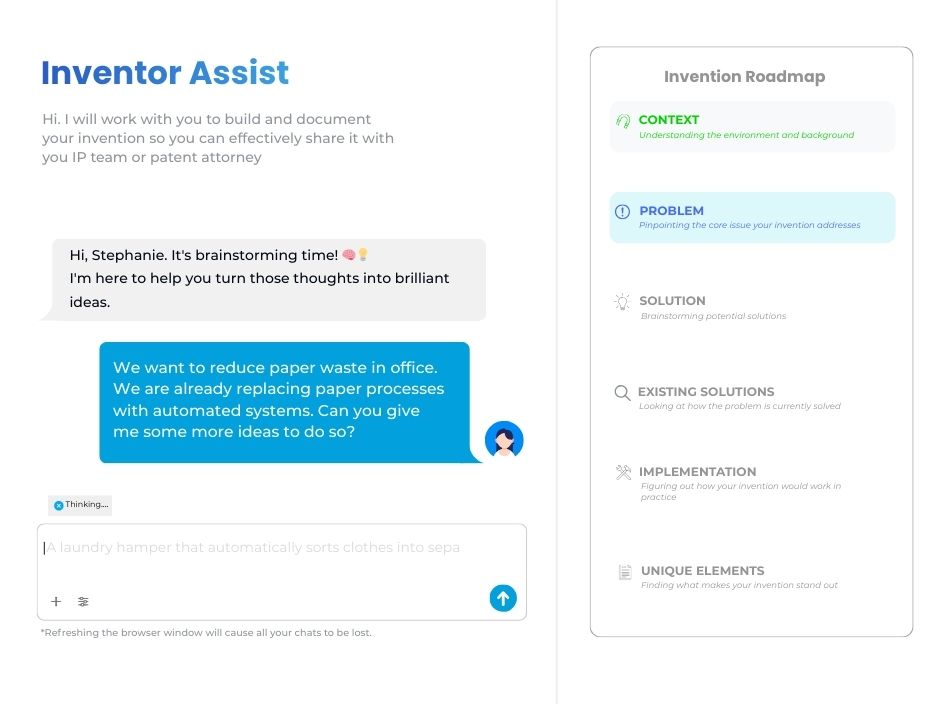
That guidance matters because most inventors are not IP professionals. They may understand the invention deeply but may not know what information legal teams require. This can create additional work downstream. Our AI-driven tool helps legal teams receive more complete disclosures and reduces repeated follow-ups.
Configurable Review Workflows
IP Assist allows organizations to configure disclosure workflows around their existing evaluation process. Different invention types can follow different approval routes. Reviewers can be assigned based on the relevant business unit, technology, geography, or invention category.
This allows the organization to maintain a consistent system without forcing every disclosure through an identical process.
Patent Committee Collaboration
The patent committee view gives decision-makers access to the complete disclosure and its review history.

Committee members can:
- Review disclosures and supporting documents
- Ask inventors questions
- Leave comments and record votes
- Document the final decision
This creates a clear record of how the decision was reached. It replaces conclusions that would otherwise be pieced together from meetings and reply-all email threads.
Early Prior Art Insights
For organizations that want an earlier indication of potential patentability, IP Assist includes optional AI prior art search, powered by PQAI. That way, inventors and reviewers can get a preliminary understanding of what already exists before the disclosure reaches outside counsel.

Source – InspireIP
Of course, this does not replace a comprehensive patent search. It can, however, help the internal team identify which ideas deserve deeper investigation and investment.
PS: You can try the AI powered prior art search tool for free here.
Integrations with Collaboration Tools and Docketing Systems
IP Assist connects with collaboration tools and major docketing systems, allowing organizations to improve invention capture without replacing their existing patent infrastructure.

The notable docketing-system integrations include Anaqua, AppColl, Equinox, Symphony, and IPfolio. Moreover, custom systems can be connected through APIs.
The invention disclosure process takes place in IP Assist. Once the organization decides to pursue a filing, the patent matter can continue in its existing docketing system. This allows organizations to improve the invention capture process without replacing the infrastructure already used for patent prosecution and portfolio management.
Security and Implementation
Security is a crucial consideration because invention disclosures contain commercially sensitive technical information. InspireIP is designed with this consideration in mind. Our tools are ISO 27001 certified and SOC 2 compliant.

Moreover, we understand that delays in deployment can mean more missed disclosures. That is why IP Assist can be deployed in weeks rather than months.
At InspireIP, our aim is to ensure that everyone involved has the context they need, whether they are inventors, committee members, or leaders. We know that the right system can help organizations protect more ideas without allowing administrative work to overwhelm the IP team.
Do you need such a system in place too? Contact our team for a demo, and we can help you close the gaps that may be allowing valuable ideas to slip through.
Frequently Asked Questions
1. What is an invention disclosure?
An invention disclosure is the first formal internal record of a new invention. It captures the technical details, the inventors involved, the date of conception, and any prior art the inventors are aware of. It’s what your IP team uses to decide whether to file a patent, and it’s the foundation your outside counsel works from when drafting claims.
2. What is the difference between an invention disclosure and a patent application?
An invention disclosure is an internal document used to evaluate whether an invention is worth pursuing. Whereas a patent application is a formal legal filing submitted to a patent office like the USPTO. The disclosure comes first and is what your team uses to make that decision.
3. What happens to disclosures that don’t become patents?
We believe they should still be retained. A disclosure that doesn’t result in a patent can still be valuable as a trade secret, defensive publication, or prior art that prevents a competitor from patenting the same idea..