Skip to content
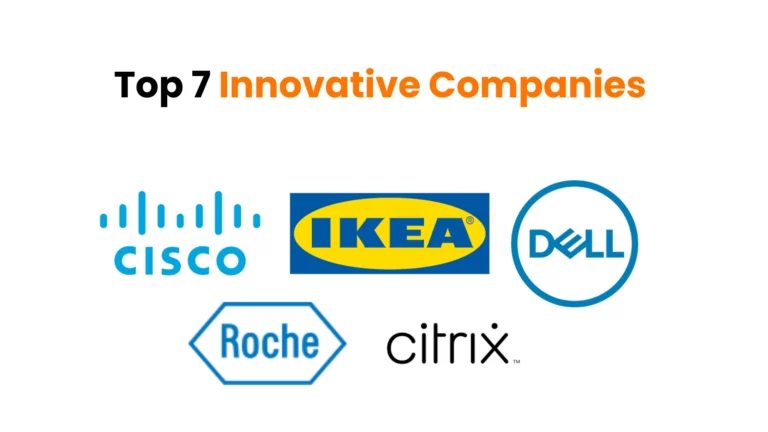
When people look for innovative companies, they’re usually trying to answer a simple question, “Who is actually innovating today and what can we learn from them?”
But the truth is, most lists repeat the same top names: Apple, Amazon, Google, Tesla.
Yes, they’re iconic, but they aren’t the only organizations redefining innovation in 2026.
What’s far more interesting (and more useful) is how a wider set of companies, across healthcare, AI, enterprise tech, sustainability, and manufacturing, are building repeatable, systematic innovation that keeps them ahead regardless of market conditions.
That’s exactly what this blog covers.
And most importantly, you’ll walk away with insights you can apply to your own innovation program whether you’re leading R&D, corporate strategy, product, or a growing innovation team.
A Quick bonus: If you want to benchmark your own company’s innovation maturity, you can right away download the Roadmap for Innovation: Ideation to Implementation free eBook.
What Makes a Company “Innovative” in 2025?
If you look at the world’s most innovative companies today, they all share a pattern and it has far less to do with flashy products and far more to do with repeatability.
In 2026, the most innovative companies consistently show five traits:
- Leadership-backed innovation
We have seen that companies with active C-suite sponsorship are 4.2x more likely to outperform peers on innovation outcomes. Innovation only works when leaders commit to it, in mindset, resources, and accountability. Read on detailed Case Studies. - A structured idea-to-implementation system
Breakthrough ideas don’t emerge by accident. Innovative companies use defined workflows to:- capture ideas
- evaluate them
- prioritize the right ones
- track execution
- protect IP
This is why structured innovation management platforms have become a critical enabler.
- Culture, not slogans
They don’t rely on “be innovative” posters. They build cultures where employees feel safe suggesting bold ideas and where those ideas actually move forward. - Customer-obsessed problem solving
Innovators don’t chase trends, they obsess over innovation challenges. Every example in this article reflects that mindset. - Continuous experimentation and learning
Innovators ship small, test fast, learn faster, and repeat. It’s the #1 behavior that separates top performers from stalled companies.
Why this matters for you?
Understanding these patterns will help you see why the companies below stand out and what you can adapt inside your own organization, regardless of size or industry.
Innovative Company Examples
90% of companies that outperform on innovation outcomes have clear C-suite ownership of the innovation agenda. – Boston Consulting Group
It couldn’t be more true. Companies translate real value into their business only if the top management focuses on commitment, talent, and investment.
Here are the companies that have understood the way to business success and mastered the process right from ideation to implementation.
1. Roche
Ranked #48 on the Global Innovation Index in the Healthcare and Biotechnology category.
Roche has quietly become one of the most consistently innovative companies in the world because of its breakthroughs in healthcare. And, because of how systematically it manages innovation across research, product teams, and global operations.
While most companies talk about “transforming healthcare,” Roche actually operationalizes it. Their long-term ambition is clear: deliver the right treatment to the right patient at the right time, and do it sustainably at scale.
Why Is Roche Considered an Innovative Company?
Here’s what makes Roche stand out:
1. They’ve built a global, inclusive innovation engine
Roche intentionally brings together talent from different geographies, disciplines, and lived experiences.
This diversity is not a checkbox, it’s their competitive advantage.
2. They embrace multi-stakeholder innovation
Patients, clinicians, researchers, health systems, Roche co-creates with all of them.
Their innovation isn’t isolated within R&D labs; it’s ecosystem-driven.
3. They use structured innovation management
Roche introduced centralized innovation management systems to:
- connect teams across continents
- simplify complex R&D workflows
- align projects to strategic priorities
- accelerate decision-making
This is the “invisible infrastructure” behind their innovation velocity.
Related Read: Innovation Disclosure Pipeline Health Checklist
Roche Innovation Example
Biomarker Testing for Lung Cancer: Unlocking Earlier, Personalized Care
Roche’s biomarker testing initiative is one of the best examples of meaningful healthcare innovation today.
By partnering with patients, oncologists, diagnostic labs, and health systems, they’re enabling earlier detection and personalized treatment paths for lung cancer, one of the world’s deadliest cancers.
What makes this example worth highlighting?
- It combines science, diagnostics, and ecosystem collaboration
- It solves a real unmet need, not just a technological challenge
- It’s scalable across countries and health systems
- It reflects Roche’s innovation philosophy: precision, partnership, patient-first
What You Can Learn from Roche
If there’s one theme that repeats across Roche’s innovation stories, it’s this: Innovation only works when there’s a system that supports it.
From employee-driven ideation to centralized workflows and cross-functional execution, Roche has built an innovation model that’s both disciplined and human-centered, and that’s exactly why they keep creating impact consistently.
2. IKEA
Ranked #32 on the Global Innovation Index in the Sustainability and Consumer Goods category.
IKEA might be known for flat-pack furniture and meatballs, but behind the scenes, it’s one of the most quietly disruptive and consistently innovative companies in the retail world.
What makes IKEA especially interesting as an innovation case study is that it operates at an almost impossible scale, 350+ stores across 50 countries, yet still manages to evolve faster than smaller competitors.
And they don’t innovate for the sake of novelty.
They innovate with purpose. You can say the keywords are accessibility, sustainability, affordability, and simplicity.
Why Is IKEA Considered an Innovative Company?
1. They built a culture of intrapreneurship
Innovation at IKEA doesn’t “belong” to a department.
Every employee is encouraged to improve products, rethink processes, or bring forward new ideas, no matter their role.
This bottom-up innovation culture is one of IKEA’s biggest competitive advantages.
2. Leaders actively champion innovation
IKEA’s top management is famously hands-on with innovation.
Executives don’t just approve ideas, they participate in co-creation, customer interviews, and sustainability pilots.
3. They innovate through customer obsession
From the layout of their stores to the design of their most popular products, IKEA looks for simple ways to solve everyday problems for people at home.
4. They run structured, continuous product development
Despite their massive scale, IKEA uses centralized innovation management to:
- capture employee ideas
- run global innovation challenges
- test prototypes quickly
- collaborate with designers, engineers, and suppliers
- respond to customer trends in real time
Consistent innovation is not magic, it’s process.
IKEA Innovation
ÅBÄCKEN: A Water-Saving Nozzle Designed for Everyday Sustainability
One of IKEA’s latest innovation initiatives is the ÅBÄCKEN water-saving nozzle. A tiny attachment with a big impact.
- Two modes: mist and spray
- Designed to drastically reduce water usage for daily home activities
- Created in partnership with internal innovators exploring sustainable home habits
This product is part of IKEA’s broader push towards sustainable water use and circular design.
Hanna Carleke, one of IKEA’s business leaders, shared that the company is continuing to develop more product lines that nudge people toward environmentally conscious behavior at home. This includes the upcoming water-recycling shower system, designed to reduce water waste at scale.
This is IKEA’s innovation thesis in one sentence: Small interventions and massive scale lead to global impact.
What You Can Learn from IKEA?
IKEA proves that innovation doesn’t require futuristic technology, it requires systems, culture, and customer empathy.
Their lessons:
- Empower employees to suggest and own ideas
- Back innovation with leadership involvement
- Build processes that make iteration fast
- Focus on solving real human problems, not chasing trends
This is what keeps IKEA relevant decade after decade.
3. Cisco
Ranked #17 on the Global Innovation Index in the Enterprise Tech and Networking category.
Cisco is one of the few legacy tech giants that has successfully reinvented itself multiple times, from hardware to software, from networking to cybersecurity, and now toward an AI-first future.
And unlike many companies that rely on acquisitions to appear innovative, Cisco’s real strength lies in how it mobilizes its massive global workforce to innovate from within.
Cisco doesn’t just encourage innovation.
It engineers it with scale, structure, and relentless clarity.
Why Is Cisco Considered an Innovative Company
1. Innovation through massive, global-scale crowdsourcing
Cisco has more than 13,000 employees spread across 13 countries working directly on innovation programs.
Their internal innovation system allows employees to:
- propose solutions to live business problems
- co-develop prototypes
- collaborate across time zones
- vote on and refine ideas
- turn prototypes into funded initiatives
This approach replaces siloed R&D with community-driven innovation.
2. A co-creation model embedded into daily operations
Rather than isolated hackathons, Cisco builds co-creation into:
- customer engagements
- partner ecosystems
- product roadmaps
- cybersecurity simulation
- supply chain resilience projects
This gives them continuous input from the people who use (and break) their systems every day.
3. Clear business alignment (this is Cisco’s superpower)
At Cisco, business innovation isn’t “nice to have.”
It directly contributes to revenue, customer retention, and strategic growth.
Teams are trained to ask, “How does this idea solve a problem our customers are facing right now?”
This business-first philosophy is why Cisco often turns ideas into commercial products faster than their competition.
Cisco Innovation Example
The AI-First Security Cloud
Cisco is building an AI-driven security architecture designed to simplify and automate security operations for global enterprises, a major challenge as cyber threats become more complex.
Key innovation elements:
- Consolidates dozens of disjointed security tools
- Uses AI to accelerate threat detection
- Automates responses to minimize downtime
- Designed for hybrid and multi-cloud environments
- Integrates with existing Cisco network infrastructure
This initiative shows how Cisco leverages its strengths, networking dominance and cybersecurity expertise as well as massive customer ecosystem to create innovation with immediate real-world value.
Related Read: Cisco’s new SSE solution
What You Can Learn from Cisco?
Cisco’s innovation advantage comes from participation at scale. They’ve built an environment where:
- Employees don’t wait for permission to innovate
- Customers co-create with product teams
- Leaders quickly green-light experiments that solve real problems
- Innovation is measured, not romanticized
It’s not just a process, it’s a rhythm.
4. Dell
Dell isn’t flashy like Tesla or moon-shot driven like Alphabet and that’s exactly why its innovation story is underrated.
In 2024–2025, Dell became one of the most strategically innovative enterprise tech companies, not because of one breakthrough, but because of how it’s rebuilding the backbone of global AI deployment.
Dell’s innovation is not loud.
It’s infra-deep, enterprise-first, and directly tied to scale, sustainability, and cost-efficiency, the three things CIOs and CTOs care about in 2026.
Why Is Dell Considered an Innovative Company?
Here’s where Dell stands out: while most companies are talking about AI, Dell is quietly building the actual systems, hardware ecosystems, and deployment frameworks that allow companies to operationalize AI at scale.
Three innovation behaviors make Dell uniquely relevant today:
1. AI Infrastructure That Enterprises Can Actually Deploy
Dell’s AI Factory with NVIDIA became the fastest-growing enterprise AI deployment model in the U.S. It released validated AI architectures that reduce enterprise deployment time by ~30–40%. And it even expanded its sovereign AI offerings for governments, banks, and healthcare institutions needing strict data controls.
They’re simply building AI ecosystems one innovation at a time.
2. Modular, As-a-Service Hardware Innovation
Dell has been ahead of the curve with modular design and “unbundled” compute infrastructure.
In 2025:
- APEX (Dell’s Everything-as-a-Service model) grew double digits YoY
- Enterprises are adopting APEX not just for servers, but for HPC, storage, multi-cloud ops, and even workplace device fleets
- The modular design reduces upgrade cycles and slashes e-waste (a major innovation differentiator)
This model is a quiet revolution: Companies no longer buy hardware, they scale it like cloud. Dell essentially turned infrastructure into a subscription-based innovation engine.
3. Sustainability as a Technology Innovation Strategy
Dell’s sustainability isn’t CSR. It’s engineering-led. For instance:
- Consider Dell’s 2025 “Concept Luna” framework which pushed ultra-modular laptops that can be disassembled in seconds.
- 50%+ of new enterprise devices now include recycled or upcycled materials
- Dell is one of the few hardware giants to tie sustainability directly to serviceability, total cost of ownership, and energy efficiency of AI workloads
This is why Dell keeps winning long-term enterprise contracts: It’s not just green, it’s operationally smarter.
What You Can Learn from Dell?
Dell’s innovation strategy shows that speed and structure can co-exist. Their success isn’t random bursts of creativity, it comes from running disciplined, recurring, challenge-driven innovation programs across a global workforce.
- Innovation accelerates when employees have a formal space to submit, refine, and test ideas.
- The fastest innovators run short, iterative R&D sprints instead of long annual cycles.
- Global teams innovate better when supported by a centralized idea management system that reduces friction, not adds to it.
- Customer insights become innovation fuel when they are captured systematically, not accidentally.
- Dell proves that when you operationalize ideation, innovation becomes predictable.
5. Citrix
Citrix is often mistakenly bucketed as “VDI software,” but 2025 has completely changed its innovation arc.
After becoming part of Cloud Software Group, Citrix shifted from a traditional virtual desktop company to a modern digital workspace and secure access platform powering some of the world’s most hybrid and distributed organizations.
Citrix’s innovation is shaped by one truth: Hybrid work has matured, but complexity has exploded.
And Citrix is innovating specifically to reduce that complexity across apps, devices, networks, and locations.
Why Is Citrix Considered an Innovative Company?
1. Reinventing the Workspace with AI-Driven Contextual Access
In 2025, Citrix is enhancing them with intelligence. So, what’s new:
- Citrix Workspace Intelligence Layer (2024–2025) uses AI to anticipate workflows and pre-load the resources users need
- AI-powered anomaly detection strengthens zero-trust security by learning patterns across distributed teams
- Productivity insights help IT teams reduce session issues by up to 40%, improving remote employee experience
This is not consumer-facing AI. It’s operational AI built for enterprise-grade hybrid work.
2. Ultra-Efficient Virtualization for AI-Heavy Workloads
As companies adopt generative AI internally, their compute requirements spike and Citrix has quietly become one of the leading players solving this.
3. Deep Integration with Multi-Cloud, Zero Trust, and DaaS Architectures
Citrix is now a backbone for companies that run global workforces across hybrid and multi-cloud ecosystems.
- Expanded support for Azure, AWS, Google Cloud, and sovereign cloud deployments
- Faster provisioning and zero-touch onboarding for distributed teams
- Strengthened integration with zero trust platforms (NetScaler, Zscaler, and other partners)
- Growth of Citrix DaaS, which now provides more flexible consumption models for fluctuating hybrid workforces
This is the part competitors struggle to replicate: Citrix is enabling remote access, sure, but it’s enabling secure, policy-driven digital operations across the entire enterprise.
What You Can Learn from Citrix?
Citrix demonstrates how innovation becomes a competitive advantage when it’s treated as a company-wide responsibility, not a department silo.
- Innovation adoption skyrockets when every employee, not just “creatives,” is invited into the process.
- Having automated idea evaluation workflows keeps teams focused and reduces stagnation.
- Aligning innovation projects with real operational challenges leads to faster market wins.
- A clear innovation program builds resilience during uncertain periods (like the post-pandemic shift Citrix navigated).
Citrix proves that culture-driven, system-supported innovation outperforms ad-hoc brainstorming every time.
5. Google Gemini
If Roche innovates in healthcare and Citrix in hybrid workspaces, Google’s Gemini Nano Banana represents a very different kind of innovation.
It’s a consumer-facing breakthrough that reshaped how people interact with generative AI visuals in 2025.
Nano Banana is a next-generation AI image generation and editing model built into Google’s Gemini ecosystem. What makes it noteworthy for innovation leaders is that it turned generative AI from a nerd-centric tool into something millions use instinctively for creative expression, storytelling, and social content.
Why Nano Banana Is a Standout Innovation Example?
1. It democratized professional-quality image editing
Nano Banana lets users create or edit high-quality images, even 3D-style figurine visuals, using simple natural language prompts inside Google’s Gemini app. Even users without technical or design skills can produce striking visuals.
2. It significantly drove user engagement and growth
Google reported that the popularity of Nano Banana contributed to millions of new Gemini users globally, with hundreds of millions of images generated shortly after launch.
The trend was viral. Social platforms across regions saw users share Nano Banana creations, from miniature figurines of themselves to stylized portraits, accelerating adoption far beyond traditional tech audiences.
3. It blends usability and multimodal AI innovation
Unlike traditional image editors or even earlier AI image-generation tools, Nano Banana works with:
- Native multimodal generation, understanding text and image context together
- Consistent character rendering, preserving people and objects across edits
- Iterative natural language refinement, reducing friction in creative workflows
What You Can Learn from Nano Banana’s Innovation?
Nano Banana exemplifies impact-oriented innovation, focusing on outcomes that matter to users (ease of use, quality, shareability) rather than just underlying technology specs.
- Make innovation accessible: Tools that feel intuitive attract wider adoption.
- Leverage multimodal AI: Combining text and image understanding expands creative possibilities.
- Viral catalysts matter: Trends that spread socially can drive usage leaps and broaden product ecosystems.
6. BYD
If you’re looking for a company that’s innovating quietly but at massive scale, BYD (Build Your Dreams) is one of the most important examples of modern innovation because of engineering discipline, speed of execution, and radical vertical integration.
In 2024, BYD surpassed Tesla in global EV sales. In 2025, it’s on track to reshape not just electric mobility, but batteries, energy storage, and mass-market EV affordability worldwide.
BYD is a perfect innovation example for leaders because it proves that innovation isn’t always flashy, sometimes it’s about process, supply chain, and relentless iteration.
Why Is BYD Considered an Innovative Company?
1. Battery Innovation That Changed the Economics of EVs
BYD’s core differentiator is its mastery over battery chemistry and manufacturing. What exactly sets them apart:
- Blade Battery: BYD’s iron-phosphate (LFP) “Blade Battery” achieved global recognition for being safer, more stable, and more durable than traditional lithium-ion cells.
- Mass-manufacturing advantage: BYD produces batteries in-house, reducing dependency on suppliers and lowering production costs.
- Sodium-ion breakthrough: BYD began integrating sodium-ion batteries into mass-market vehicles, a move that reduces reliance on lithium and lowers EV entry prices.
This is innovation with direct market impact because of safer and cheaper EVs as well as faster production cycles.
2. Vertical Integration as a Strategic Innovation Model
While most automakers outsource key components, BYD builds:
- batteries
- motors
- inverters
- chips
- vehicle software
- energy modules
- manufacturing equipment
This end-to-end control allows BYD to move from idea to prototype and mass production faster than any competitor in the EV industry.
3. BYD’s 2025 “e-Platform 4.0” & Vehicle Intelligence
- BYD’s new e-Platform 4.0 (launched 2024–2025) focuses on three innovation pillars:
- Smarter architecture: Centralized computing and zonal vehicle controllers
- Efficient motors: Ultra-efficient electric drive systems with 90%+ energy conversion
- AI-enhanced driver assistance: Advanced perception + real-world driving data to improve ADAS accuracy
This isn’t meant to compete with Tesla’s FSD; it’s designed to create affordable intelligence at scale for millions of vehicles, not a niche premium category.
4. Affordable EV Innovation for Emerging Markets
Unlike most EV companies focused on premium buyers, BYD innovates for mass adoption:
- Launched sub-$15,000 EVs, making clean mobility accessible
- Became the fastest-growing EV brand in Southeast Asia, Latin America, and the Middle East
- Built localized factories and assembly lines to reduce export costs
- Partnered with governments for clean transportation (buses, taxis, fleets)
This is one of the greatest examples of innovation as inclusion, not innovation as luxury.
What You Can Learn from BYD?
BYD’s rise was driven by operational innovation and relentless vertical integration. Key lessons for your organization:
- Owning your core processes dramatically increases your innovation speed and independence.
- Cost innovation is just as powerful as product innovation, especially in competitive markets.
- Breakthroughs like sodium-ion or Blade Battery show the power of material-level innovation, not just UI-level changes.
- Innovation becomes sustainable when focused on scalability and accessibility, not only premium buyers.
- BYD proves that innovation wins when it’s repeatable, manufacturable, and economically smart.
7. Adobe
Few companies have managed the generative-AI shift as gracefully as Adobe.
Instead of reacting to AI disruption, Adobe absorbed it, turning its Creative Cloud ecosystem into one of the most advanced, enterprise-ready creative AI platforms in the world.
Why Is Adobe Considered an Innovative Company?
1. Firefly: Enterprise-Safe Generative AI Built for Real Brands
Adobe Firefly, now embedded across Photoshop, Illustrator, Premiere Pro, Express, and Experience Cloud, has become a global benchmark for brand-safe AI content generation.
What makes Firefly different?
- Trained on licensed + Adobe-owned data
- No copyright minefields. No training data mysteries. No unlicensed scraping.
- Comes with commercial-use guarantees
- Creatives and brands can publish Firefly outputs without legal ambiguity.
- Built-in content authenticity controls
Every generated asset includes Content Credentials, a cryptographically secure metadata standard that shows whether AI was used.
This is innovation rooted in responsibility, something corporations value heavily.
2. AI-Powered Workflows Across Creative Cloud
Adobe wasn’t content with adding AI as a plug-in. It rewired its creative apps around modular AI actions, such as:
- Generative Fill and Generative Expand in Photoshop
- Text to Vector and Generative Recolor in Illustrator
- Auto Cutout, Audio Enhance, and Cut Detection in Premiere Pro
- Text-to-Template and Brand-Consistent Design Suggestions in Adobe Express
The result?
Tasks that took hours now take minutes without removing the creative control professionals require.
This is Adobe’s core strength: AI that accelerates creativity, not replaces it.
3. Adobe’s Real Innovation Engine: The New “Creative Cloud + Experience Cloud” Loop
This is the innovation story few people talk about.
Adobe is connecting AI-generated content (Creative Cloud) with personalization engines and customer journeys (Experience Cloud).
For instance, a marketer can generate campaign assets in Express, push them into Experience Cloud, and instantly deploy personalized versions to millions of customers.
This loop is Adobe’s biggest competitive advantage because it integrates:
- creative production
- marketing automation
- analytics
- personalization
- AI content generation
No other company matches this end-to-end creative and marketing innovation cycle.
4. Generative AI for Video: Adobe’s Hollywood Advantage
Adobe’s dominance in film, animation, and post-production means its AI video innovation hits at enterprise scale.
And Adobe’s upcoming Project Stardust, an AI-powered object-aware editing engine, is expected to transform how creators manipulate layered images and motion graphics.
This is production-grade innovation used by agencies, studios, broadcasters, and enterprises.
What You Can Learn from Adobe?
Adobe is the perfect example of how to embrace disruptive technology (AI) without losing brand trust or creative integrity.
- Innovation should balance speed with responsibility, enterprise adoption depends on safety and compliance.
- The future belongs to companies building end-to-end innovation ecosystems, not isolated tools.
- Successful innovation enhances, not replaces, skilled professionals.
- Transparency (like Adobe’s Content Credentials) builds long-term trust and differentiates you in an AI-heavy world.
Adobe proves that the most sustainable innovation is responsible, user-centric, and deeply integrated.
What All Innovative Companies Have in Common?
When you look at Roche, Dell, Citrix, Gemini (Google), BYD, and Adobe, they may operate in wildly different domains, but the underlying innovation engine looks strikingly similar. Here’s what ties them together.
1. A Centralized Idea-to-Implementation System
None of these companies leave innovation to scattered spreadsheets, siloed teams, or “someone should pick this up later” Slack threads.
They run innovation like a machine. Ideas enter from anywhere, get evaluated systematically, approved with clear ownership, and executed with trackable workflows.
(This is exactly what 90% of growing companies struggle with, and exactly what InspireIP solves.)
2. C-Suite Support from Day Zero
Innovation doesn’t scale unless executives take it personally.
Every company on this list has leadership that champions experimentation, protects innovation budgets, and actively removes friction for teams.
3. Clear Challenges and a Healthy Innovation Pipeline
They don’t wait for brilliant ideas to “show up.” They constantly run targeted challenges:
- BYD: cost-down EV engineering sprints
- Adobe: new creator-centric workflows
- Dell: supply chain automation challenges
- Google Gemini: foundational model experiments
Essentially, clear problems fuel better ideas, and keep the pipeline alive.
4. Repeatability (The #1 Differentiator)
Innovation isn’t vibes. It’s a repeatable process. These companies built systems where:
- Ideas move through the same lifecycle
- Decisions are consistent
- Data, not gut feeling, drives prioritization
- Teams know exactly what happens next
5. Employee Engagement Isn’t an Afterthought
Whether it’s Adobe’s “Kickbox,” Dell’s internal hackathons, or BYD’s engineering pods , employees aren’t bystanders; they’re co-innovators.
This increases idea volume and quality.
6. IP Strategy Always Comes Built-In
The best companies don’t treat IP as paperwork at the end. They:
- Identify patentable ideas early
- Run novelty checks
- Capture disclosures in structured workflows
- Protect strategically
This is why their innovation doesn’t leak, it compounds.
Want to Build an Innovation Program Like These Companies?
Get the exact same structured workflow the world’s most innovative brands use, from idea capture and evaluation to implementation and patent protection.
Start your free 30-day idea-to-IP workflow trial with InspireIP. Or, Book a Demo for an interactive session.
Something for you to think about
What’s more interesting is that even if we chose to talk about the top ten or twenty innovative companies, you would have found the same result.
They all establish a strong innovation program that reaps in-house and business benefits for them.
Because what is innovation in business if not creative ideas implemented by strong leadership? Time and again, we have witnessed that leaders in innovation have leveraged top talent to increase their company’s innovation velocity.
And those who don’t, well, here’s what happens to them: Archives