Skip to content
Idea theft in the workplace is neither rare nor subtle.
Recent organizational research shows that idea theft, knowledge theft, or misattribution is experienced, committed, or witnessed by over 90% of employees across industries. Even more concerning, employees lose the motivation to share them again.
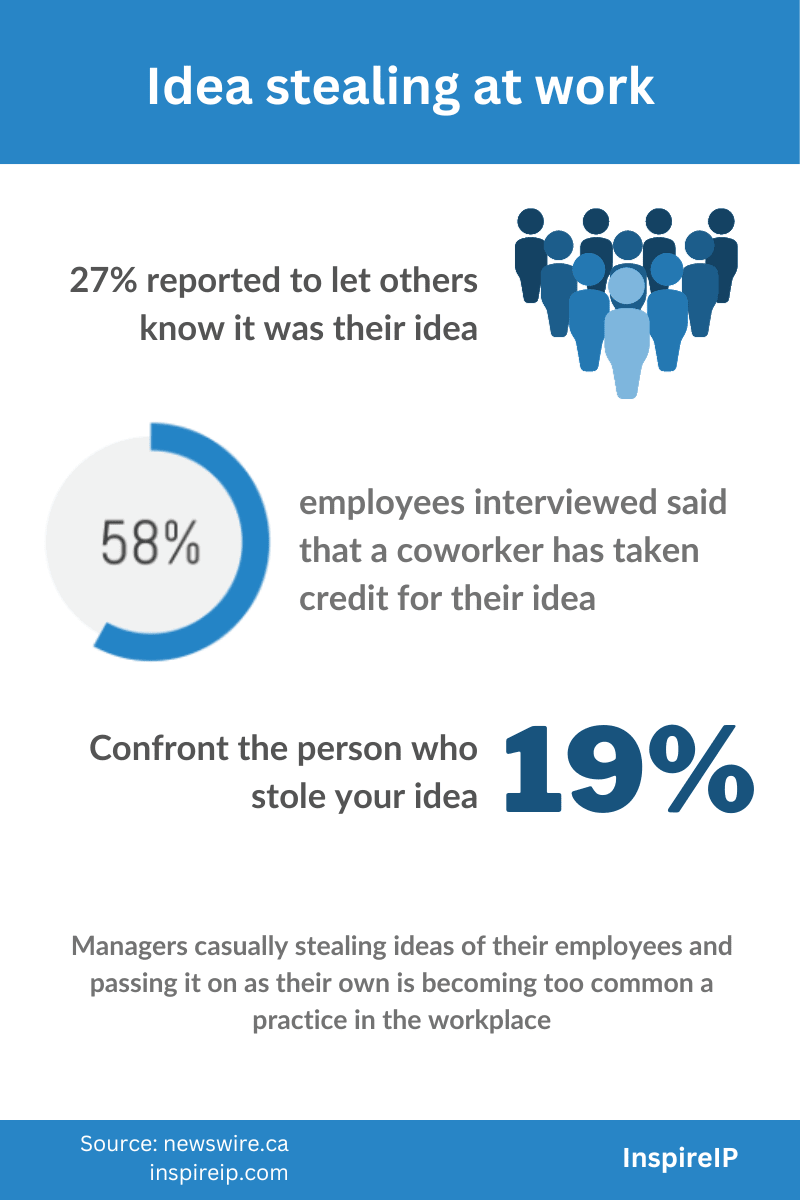
In fact, according to a survey on idea theft in the workplace by OfficeTeam, Newswire, “Nearly six in 10 employees interviewed said that a coworker has taken credit for their idea.”
And, if you read a survey on knowledge workers by Forbes, you’ll find that one in every three employees has had their ideas stolen at work.
It’s sufficient to assume and declare that idea theft is a common malpractice at work.
This is why organizations struggling with innovation often don’t have a creativity problem. They have a psychological safety and process problem.
Until organizations fix how ideas are attributed, captured, and progressed, idea theft will continue, quietly eroding trust, collaboration, and innovation from the inside.
And its repercussions are real, too. Organizations that fail to prevent such practices see:
- No collaboration among employees and teams across verticals
- A culture of suspicion and no transparency
- Lack of a feedback loop
- Loss of intellectual property
- Gradual collapse of business operations
- An unsteady innovation strategy or a completely stagnant strategy
- Next to no business innovation
- Inadequate employee participation
- High employee churn rate
- No process for capturing innovation
So, you need to learn how to empower your employees and protect their ideas from theft.
But first, let’s get on the same page.
What is idea theft?
Idea theft in the workplace refers to the intentional or unintentional misappropriation of another employee’s intellectual contribution (ideas, insights, solutions, or creative work) without proper attribution.
Organizational researchers increasingly describe this as knowledge theft, a distinct form of workplace deviance that is far more common than financial misconduct.
Idea theft becomes the reason employees stop sharing their views, thoughts, interests, and beliefs in fear of not getting their just due. When an individual sees someone else reaping the benefits and wins of their product, it never sits well.
By nature, humans are competitive, and they naturally want acknowledgment and appreciation for their work. However, idea thefts hinder their natural progression and motivation to do more in an organization.
And since an organization needs a free flow of ideas and consistent innovation to thrive, it loses its edge in the cutthroat market.
Related Read: How to inspire innovation?
How does idea theft impact motivation?
Idea theft is among the top reasons why employees stop sharing ideas at work. They stop because experience teaches them it’s unsafe.
Research on psychological safety consistently shows that employees withdraw discretionary effort, including idea sharing, when they believe their contributions will be ignored, misattributed, or exploited.
And studies on knowledge theft show that victims become more territorial, more silent, and less collaborative. Many actively withhold information or disengage entirely, even after changing jobs.
Say you run a non-profit organization that provides free education, clothes, and meals to children. Right now, you provide supporters and investors with the option to make a donation on a yearly basis to support one child exclusively.
Within your organization, during an informal team discussion, an individual came up with the idea to provide regular updates on the child to the sponsor.
For example, if it is a child’s birthday, their sponsor will get an email with images of the cake and new clothes that were possible because of them. When the child completes a semester in the school, they receive a report card and teachers’ feedback report directly to their email.
Now, this idea is going to revolutionize your crowdfunding campaign and create an emotional bond that will enable sponsors to fund the child every year.
But in this win-win situation, there’s one person who got wronged.
The employee who actually came up with the idea didn’t get the much deserving appreciation, recognition, acknowledgment, reward, and appraisal.
Instead, the team leader did!
Because there was no trial and because other team members were wary of their position with the leader, they didn’t raise their voices either. But now, everyone, including the original inventor, has this belief that no matter how hard they work and think outside the box, the top management won’t know.
The real damage wasn’t the stolen idea, but the realization that there was no system to recognize ownership.
When attribution depends on hierarchy instead of traceability, employees quickly learn that contribution is optional and silence is safer.
The Creativity–Protection Paradox
One of the most overlooked dynamics in workplace innovation is what researchers call the Creativity–Protection Paradox.
Organizations want and need employees to share early ideas so they can be refined, validated, improved, and implemented. But employees often hesitate fearing those same early ideas are the easiest to steal.
Research by Lillien M. Ellis and Brian J. Lucas reveals a surprising insight: Idea thieves prefer early-stage ideas, not polished ones.
While creators assume theft happens after an idea is fully formed, idea thieves report feeling morally justified taking early concepts, framing it as “inspiration” rather than theft.
This mismatch explains why idea theft often happens in meetings, brainstorming sessions, or informal discussions—before anything is documented.
So what can you do about idea theft?
We have established that ideas are the real lifeline of any business, and if employees, due to fear of idea thefts, stop innovating, it could damage or even kill your business. So, here’s how you can protect their intellectual property.
Capture ideas professionally
The individual who comes up with an idea rarely has the capability, resources, and expertise to execute it completely on their own. Ideas require collaboration and networking to be built into a practical and high-end solution. Co-workers, team leads, managers, and interns are all part of the entire process.
This is where it gets confusing and messy!
Intellectual effort gets disregarded, the inventor’s psychological stakes are high, friends turn into foes, and a lot more happens. Your organization ends up becoming a toxic workplace.
And we all understand what happens when a workplace is not healthy.
So, you need a professional tool that enables every employee to:
- Submit their idea from anywhere at any time in a dedicated platform. This way, they don’t need to wait to find the right person they should talk to and with whom they can share their vision.
- Become a part of your holistic idea management process.
- Choose whether they would want a co-innovator in their project. It provides them with complete ownership of their work and makes them responsible.
- Keep every stakeholder informed and in the loop.
- Feel secure as they have a proof of ownership, timestamp, timeline, proof of concept, and all the required documentation or trail.
- See their ideas getting implemented swiftly.
- Receive their due recognition and acknowledgment.
Automate disclosing inventions
If your organization has a successful innovation program, you will receive patentable ideas. This is your chance to secure the intellectual property of your employees and your organization through invention disclosures.
We want to reiterate that ideas, no matter how novel they are, have a lifespan before they aren’t novel anymore.
Anyone can steal the idea or even conceive it naturally. So, if your employee, after investing time, efforts, and R&D funds, comes up with a groundbreaking idea, have an innovation management blueprint in place.
Every idea has a shelf life. Therefore, the quicker you capture them, disclose them, apply a patent for them, and execute them, the more benefits your business will receive.
After capturing an idea and developing it into a full-blown invention, you must equip your employees with innovation management software. It enables them to:
- Notify the world about their invention officially.
- Legally establish the date of the original conception.
- Legally protect ideas with a well-written invention disclosure.
- Include all the features because missing an important feature can directly compromise the patent claim.
- Initiate the patent application process.
- Expedite the patent filing process.
- Achieve swift recognition and acknowledgment.
- Mention the co-inventors’ details and contributions.
- Disclose the third-party or open-source software or coding used, if any.
- Explain all the technical details and diagrams included in the form thoroughly.
Related Read: How to get more invention disclosures?
Educate your employees about intellectual property
Although ideas cannot be claimed as one’s own (unless you have filed an invention disclosure, followed by a patent application), you can still educate your employees about intellectual property rights.
It instills a sense of moral obligation and responsibility in every member and helps in protecting ideas from theft. Since such rights vary from one region to another, you will have to either invite an expert to talk about them or do your own research before imparting related information.
You can also connect with a lawyer or a patent agent to discuss every aspect of IP in detail.
Create a policy against idea stealing
If an individual intentionally and with bad intentions disregards someone else’s intellectual efforts, there must be repercussions. It is difficult to set rules and regulations for such repercussions. However, you must create a guideline and policy against such practices after careful consideration. Employees must have a medium to voice their concerns and guard their ideas.
Let’s go back to the survey we talked about at the beginning of this blog. After employees admitted that most of them had been a victim of idea thefts, they were asked about their response to it. So, in response to getting their idea stolen, here’s what they did:
- Only 27% spoke up to let others know it was their idea
- 15% talked to their manager
- 19% confronted the person who stole their idea
- 41% did absolutely nothing
- 5% refrained from answering
It is a scary number to see how common it is. So, don’t let up!
Work on the organizational culture
If employees are stealing ideas, there must be a reason for it. We understand that, in the end, it is a personal choice to steal someone else’s work.
However, there may be other reasons that you, as an innovation manager or a top executive, can identify and rectify.
These reasons can be:
- No effective idea management process
- No clear innovation strategy
- The burden of coming up with novel ideas on top of their daily work
- Low morality
- No proper guidelines and standards against idea thefts
- Low team cohesiveness
- Lack of attentiveness from the top management
Find the root cause of such practices and remove them swiftly.
Related Read: The CIO’s Role in Innovation
In Conclusion: Don’t turn a blind eye
Did you know people find theft of an idea a greater sin than money theft?
Maybe it’s because intellectual efforts have a greater sense of ownership, or it’s because a person might have a groundbreaking idea once in their lifetime.
It has more weight to it.
So, when organizations turn a blind eye to idea thefts internally. They foster a culture where employees find coming up with ideas fruitless.
Contrary to popular belief, idea theft is not a thing to write off easily. It is not only about who executes first, and it is definitely not about working on the idea, even if someone stole it.
It’s about the bigger picture.
So, if you want to ensure no one in your organization suffers the same, write to us here. We’re here to answer your questions and offer a free trial for your custom tool.